
Holiday Gifts - Part III

So this is what Mike, Kai's dad, got for the holidays:


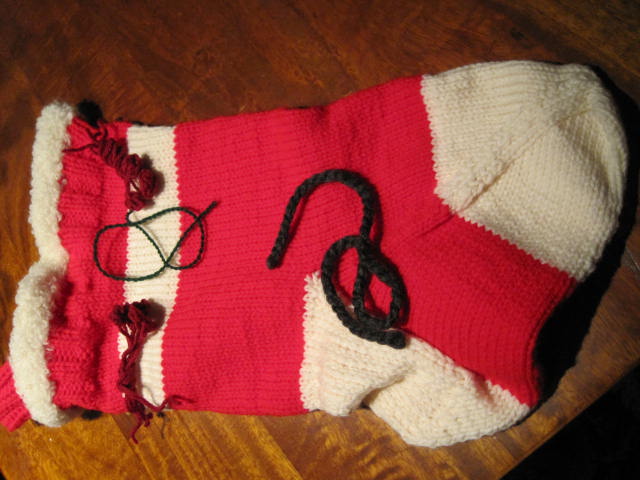
The almost complete third stocking
 As you can see it is missing a loop, Mike's name and some other decorations.  Now from my point of view it is generally 98% done, but a purest might expect that this all be done.  And of course that purest would be right.  (BTW the stocking was done with instructions Mom shared with me.  I purchased the woolly top at my LYS and am very happy with the results.)

So Kai's dad got a plastic bag with the stocking, the holly berries along with  some green and black yarn.  Now this is what it looks like:


The complete stocking
  Since we were all out of our homes for the holidays, I can't bring myself to feel too badly about not getting this completely done for 2011, but Mike, you will have it for 2012.  Tell Kai it too is not designed for him to use the loop as a head band.

Comments

Popular posts from this blog

Anatomy of a Sock

I've been knitting socks for a relatively short time.  One of the disconcerting things for me as I started following patterns for socks is the pattern designer assumes the knitter (in this case that would be me) knows all the parts of a sock.  So I thought I'd devote a post to improve my own knowledge about the anatomy of a sock and maybe some of you will learn something about the humble yet necessary sock as well. Here's the names of the parts of the foot as I know them. #49 ankle, #50 heel, #51, instep, #52 ball, #53 big toe, #54 toe, #55 little toe, #56 toenail. There are some parts more important for this discussion; first the heel of a foot is generally used to refer to the entire C-shape from the ankle to the instep.  Speaking of the instep, it refers to that curve near the bottom of the foot.  And what seems to be missing in the design above is the sole which generally refers to the bottom of the foot in total or plantar aspect in more technical terms...

Yarn Usage II: Crochet vs. Knit

All four swatches were made.  Each is 6.25" or 15.875 cm square; each prepared with the same sized yarn and needles or hook.  It took 25 stitches to get the appropriate width for the knit swatches and only 20 stitches for both of the crocheted squares.  That already says something, but I'll get to it in a minute.  (Don't know what I'm talking about here?  Check out this post first.) Unfortunately, you'll just have to trust me that four swatches were prepared and that they were all the same size.  In the excitement to get to measuring and weighing of the swatches, no photographic evidence was taken.  Luckily for me the results of this research doesn't have to be reviewed by a jury of my peer.  This blog post will be the sum and total of where this information is published. The remains of my four swatches What can be shared, however, are the balls of yarn rewound after the weighing and measuring was completed.  You will note the size ...

Knitting-Related Guinness World Records

I had to share some of the Guinness World Records connected with knitting.  It is amazing to me the type of skill, stamina and unique characteristics these record holders have in common. How about trying to knit with these SPNs?? Ingrid Wagner and her large needles and knitted swatch The largest knitting needles measured 3.5 m (11 ft 5.8 in) long and had a diameter of 8 cm (3.15 in). Ingrid Wagner, a rug and art creation artist, from the UK used the needles to knit a tension square of ten stitches by ten rows at the Metro Radio Arena, Newcastle upon Tyne, UK, on March, 10 2008.  (And I complained about getting certain SPNs stuck in my clothes.)  See how this swatch was done with merely 5 people managing the needles.  And what about the yarn?  It is truly ex-bulky.  It looks like they're knitting in a warehouse, but with a wingspan of almost 24 feet or 7 m, you'd need all that space.  Or h...